There has also been an important development with my new album release. I recently heard from Illegal Art, the label who released a number of my works around 13 years ago before the label shut down. Illegal Art is starting up again (hurray!) this week (hurray!!). This time in a different form: this time around not just a sampling-related label, but now with a more genre-leaning direction. Here is their Instagram Post from a little earlier today and here is their website: https://reboot.illegalart.net/new/
The new People Like Us album is going to be called THE RHiZOME. We are aiming to release the PEOPLE LIKE US CD in September/October this year, on Illegal Art.
The PEOPLE LIKE US IndieGoGo campaign is still open where you can pledge to pre-order this album, plus a wide selection of other items including lathe-cut vinyl, and we very much welcome pledges for items which are still in stock/available.
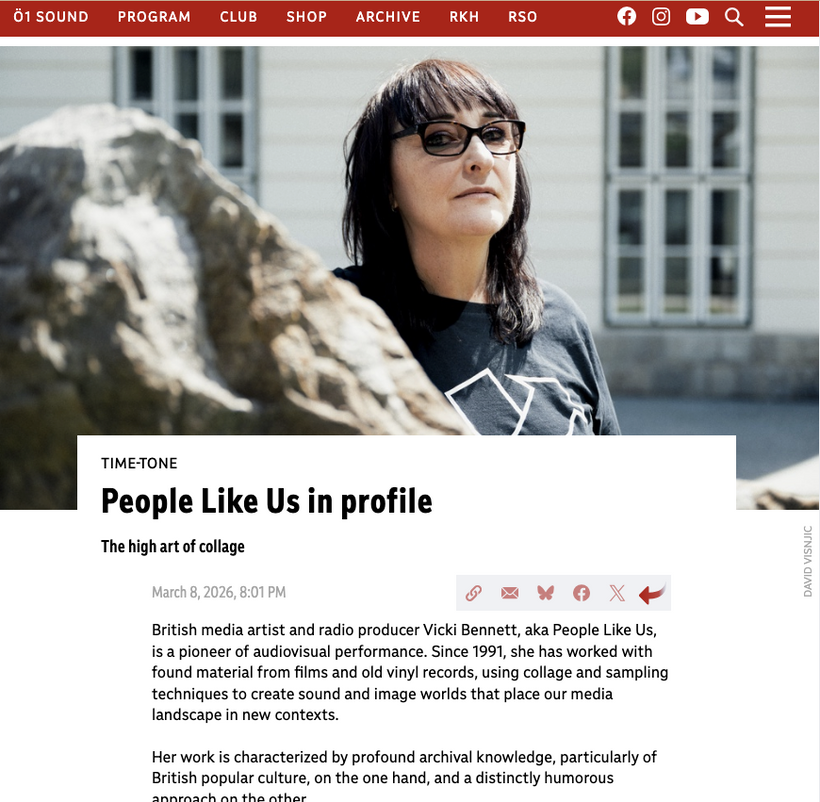
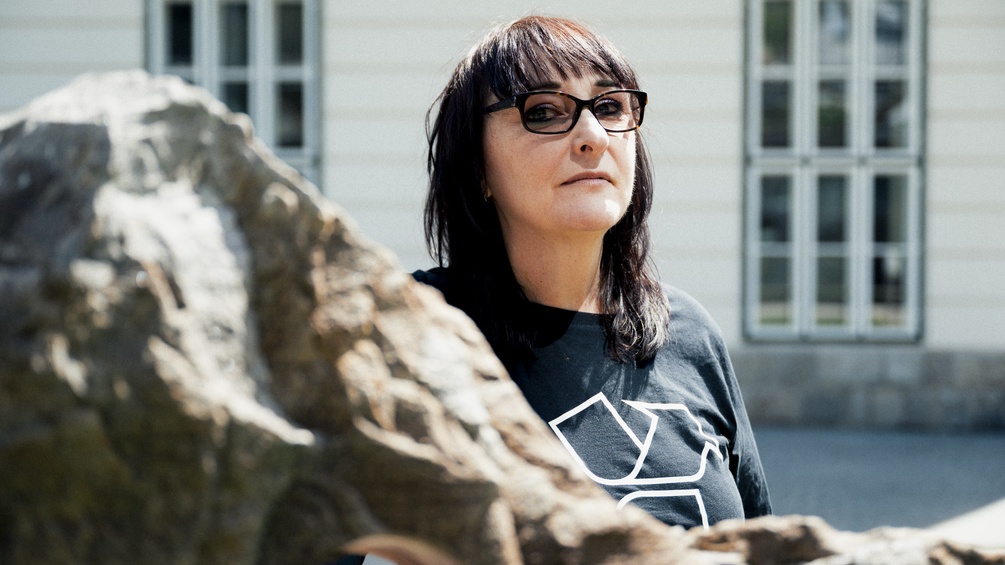
8.3. , 20-21:00: The high art of collaging: PEOPLE LIKE US in Ö1 Time-tone portrait As part of the new, three-hour time-tone on Sunday from 19:00 to 22:00 today with full program dedicated to International Women’s Day:
British media artist and radio producer Vicki Bennett aka People Like Us is a pioneer in audiovisual performances. Since 1991, she has been working with material found from films and old vinyl records and uses methods of collage and sampling to create sound and visual worlds that re-connect our media presence.
Profound archival knowledge, among other things, about British popular culture, on the one hand, and a distinctly humorous approach, on the other hand, are characterized by her creations. In 2006, she was the first artist to be given unlimited access to the BBC archives. At donaufestival 2025, People Like Us presented the Austrian premiere of their current AV work “The Library of Babel”, based on the story of Argentine author Jorge Luis Borges, a principal representative of the so-called “. Magical realism.
In this radio portrait, we traverse her work for the Prelinger Film Archive, the archive of Britain’s first electro-acoustic composer Daphne Oram, collaborations with radio host John Peel and the band Negativland, and her ‘DO or DIY’ series for non-commercial radio WFMU Vicki Bennet is a representative of artistic DIY – do it yourself. She follows the approach of “Sharity”: a combination of “share” and “charity” as well as the name of a current album by People Like Us.
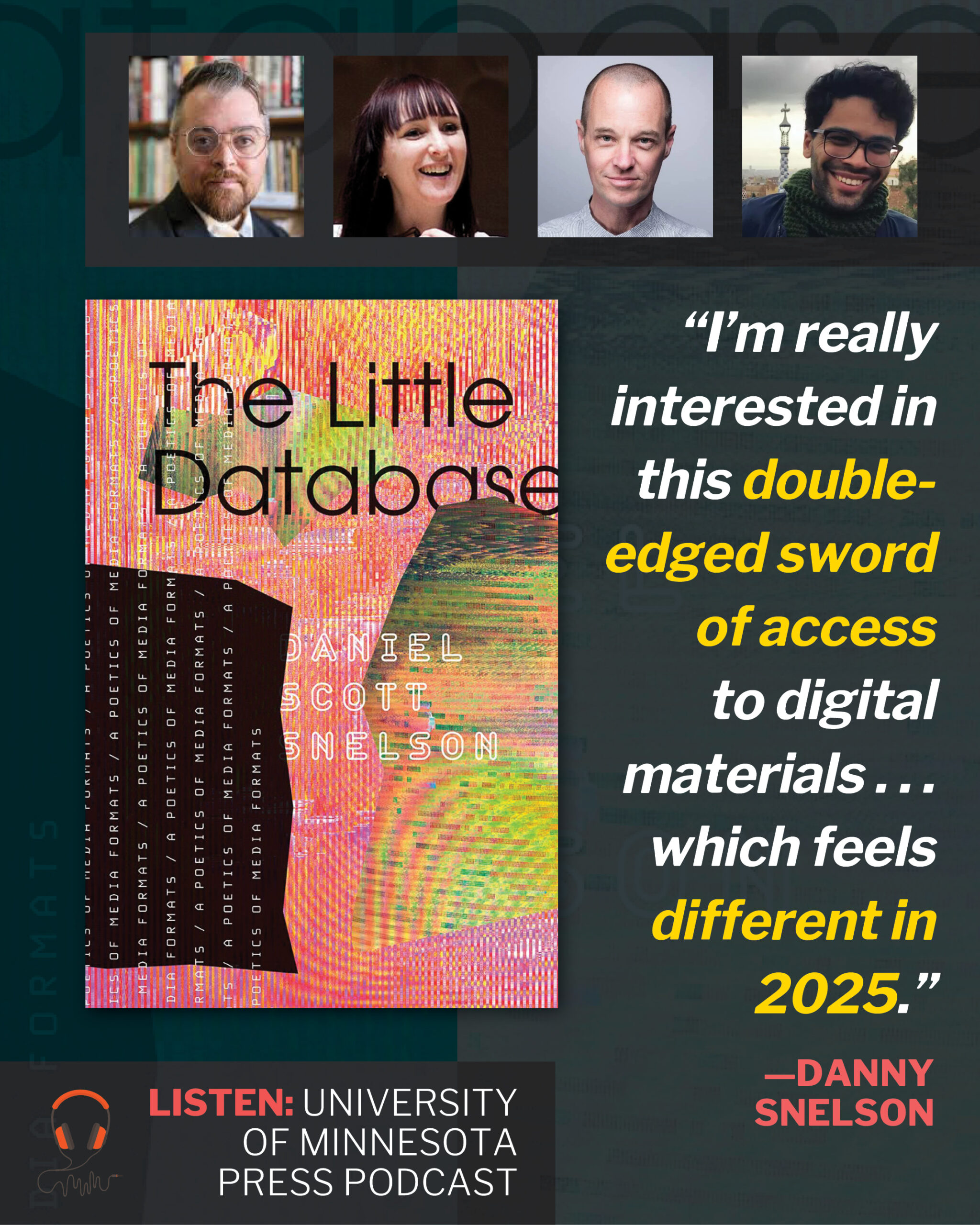
Had a fun conversation with three friends a few weeks back, which has now been edited into a podcast which you can listen to above on University of Minnesota Press site.
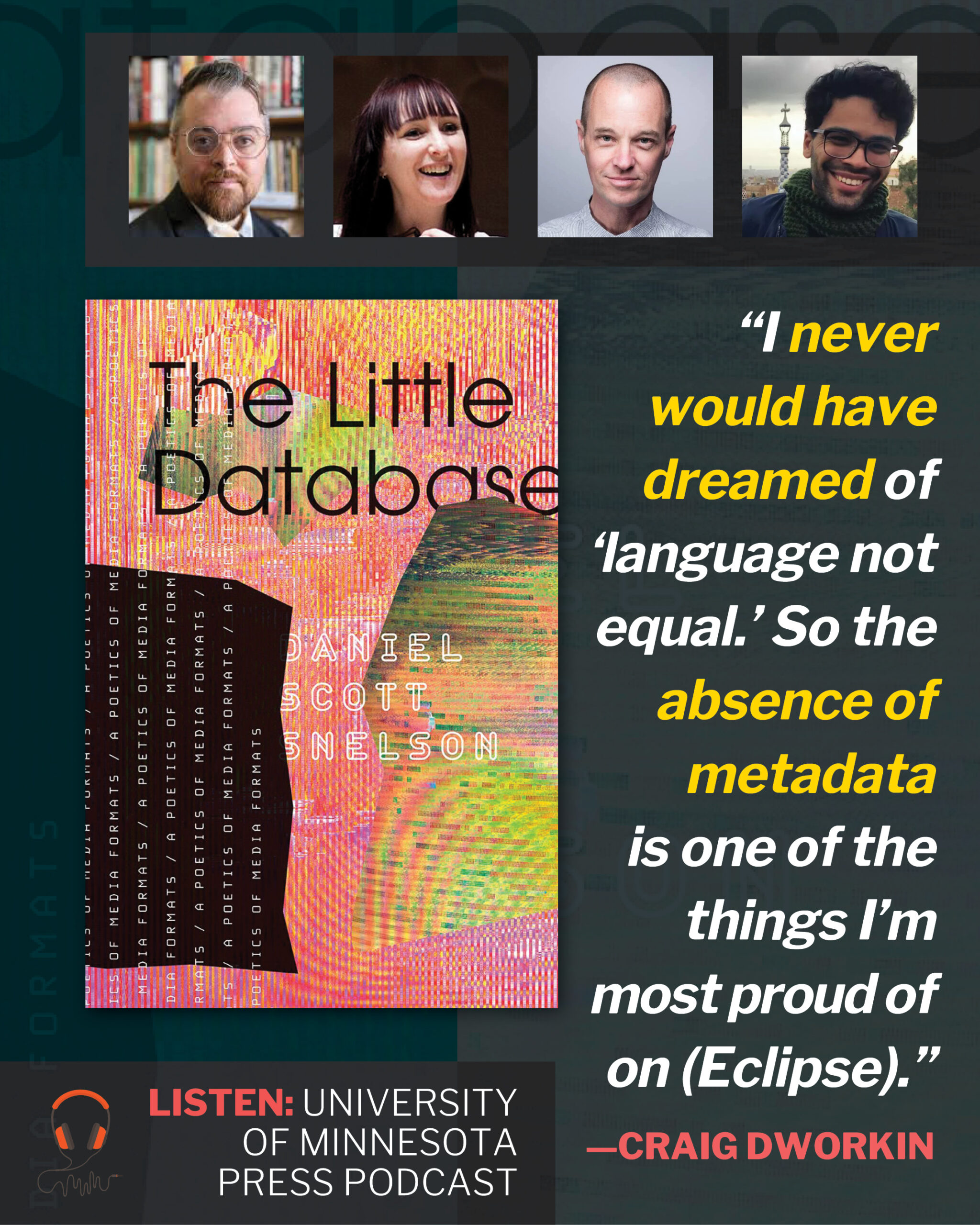
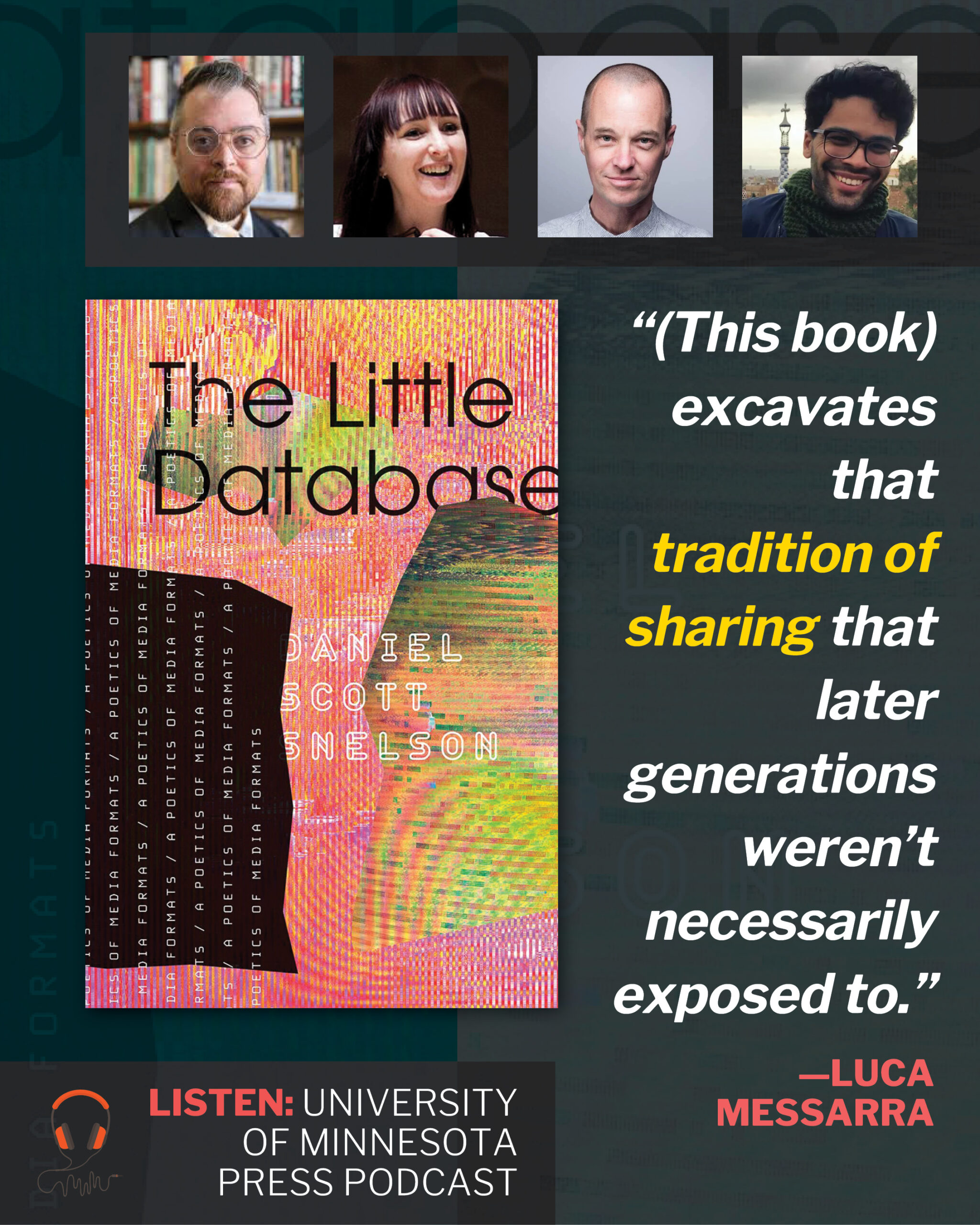
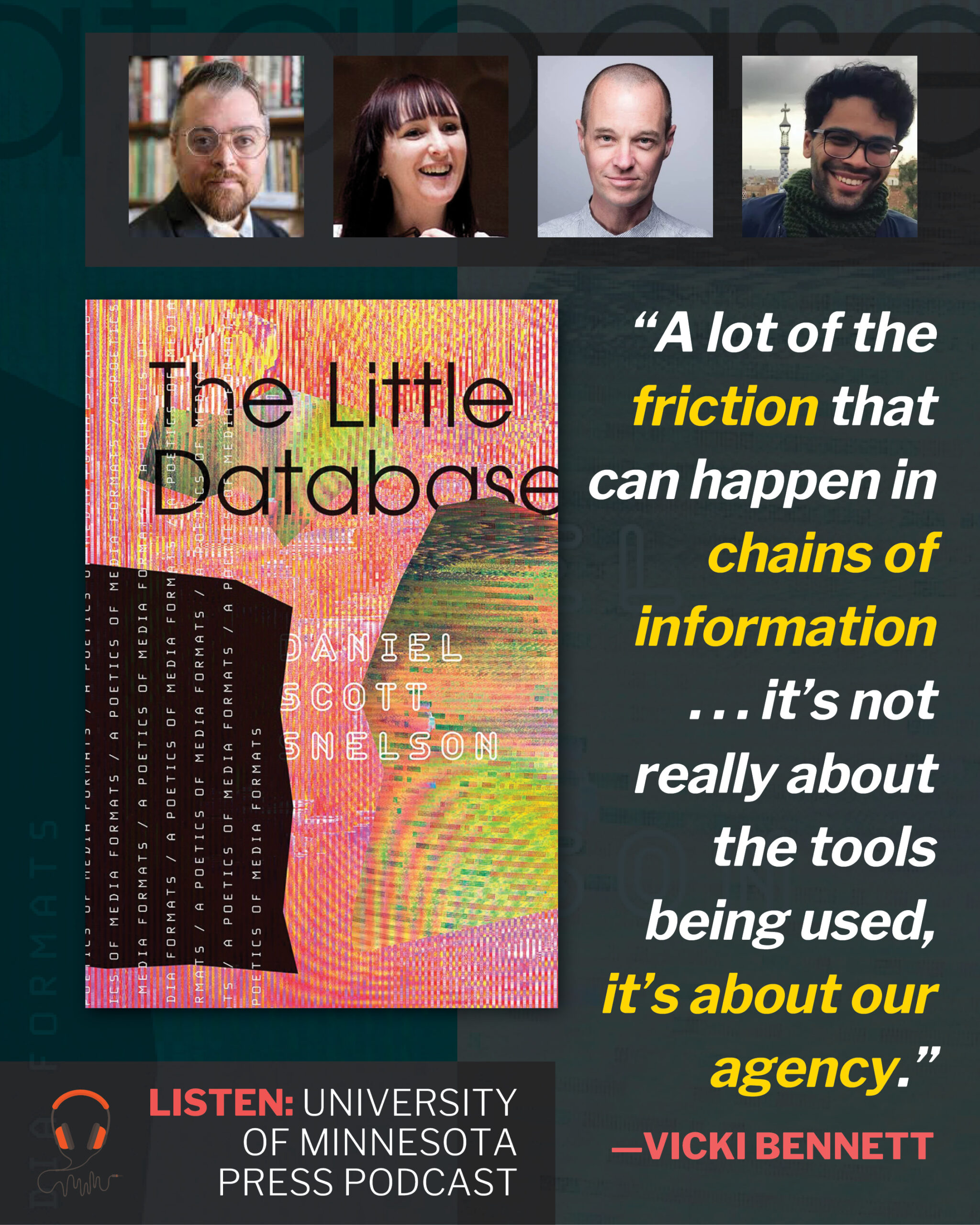
What is the opposite of “big” data? In a society where households commonly store personal archives of photos, financial records, and other documents, the “little” database—the personal data collection that is stored and backed up and not accessed frequently—deserves a category of its own. In The Little Database: A Poetics of Media Formats, Daniel Scott Snelson examines globally accessible little databases, such as Textz, Eclipse, and UbuWeb, explores how digital archives dramatically transform the artefacts they host, and asks how they might help us better understand our own private collections in turn. Snelson is joined in conversation with Vicki Bennett, Craig Dworkin, and Luca Messarra.
“Mise en Abyme” by Vicki Bennett (October 2024) Museu de Aveiro/Santa Joana, Avenida de Santa Joana, 3810-329 Aveiro, Portugal 2-20 October 2024https://www.aveiro2024.pt/en/
In this widescreen, multi-speakered spatial cinema installation created for Aveiro 2024, Vicki Bennett (People Like Us) delves into the existential depths of human experience, using dense collage and a recursive narrative to explore the intricate dance between dualism and interconnectivity. Entitled “Mise en Abyme,” the installation thrusts viewers into a realm where actors are liberated from the confines of their scripted existence, navigating a sea of pure, unmediated sensation. Traditional storytelling is reimagined, employing a fusion of audio-visual collage and sophisticated editing techniques to dismantle and reassemble digital narratives, creating a tapestry woven from images and sounds that resonate deeply within the collective unconscious through their historical associations. The thematic narrative, unbound by linear constraints, unfolds through a series of layered complexities, offering a fragmented yet coherent tale forged from a myriad of sources and the innovative ‘exquisite corpse’ technique.
“Mise en Abyme” aims to use storytelling as a vessel to navigate beyond preconceived notions and internal narratives, inviting audiences into a space where the boundaries between self and other, between individual and collective experience, begin to blur.
The Artistic Technique
Vicki Bennett creates a sophisticated blend of audio-visual collage, layering historical and contemporary images and sounds to create a rich, immersive experience. The recursive narrative structure allows for a non-linear exploration of themes. The use of the ‘exquisite corpse’ technique further enhances this experience, as disparate elements are juxtaposed and interwoven, creating a seamless yet complex narrative tapestry. This method not only highlights the beauty of randomness but also demonstrates the interconnectedness of seemingly unrelated elements.
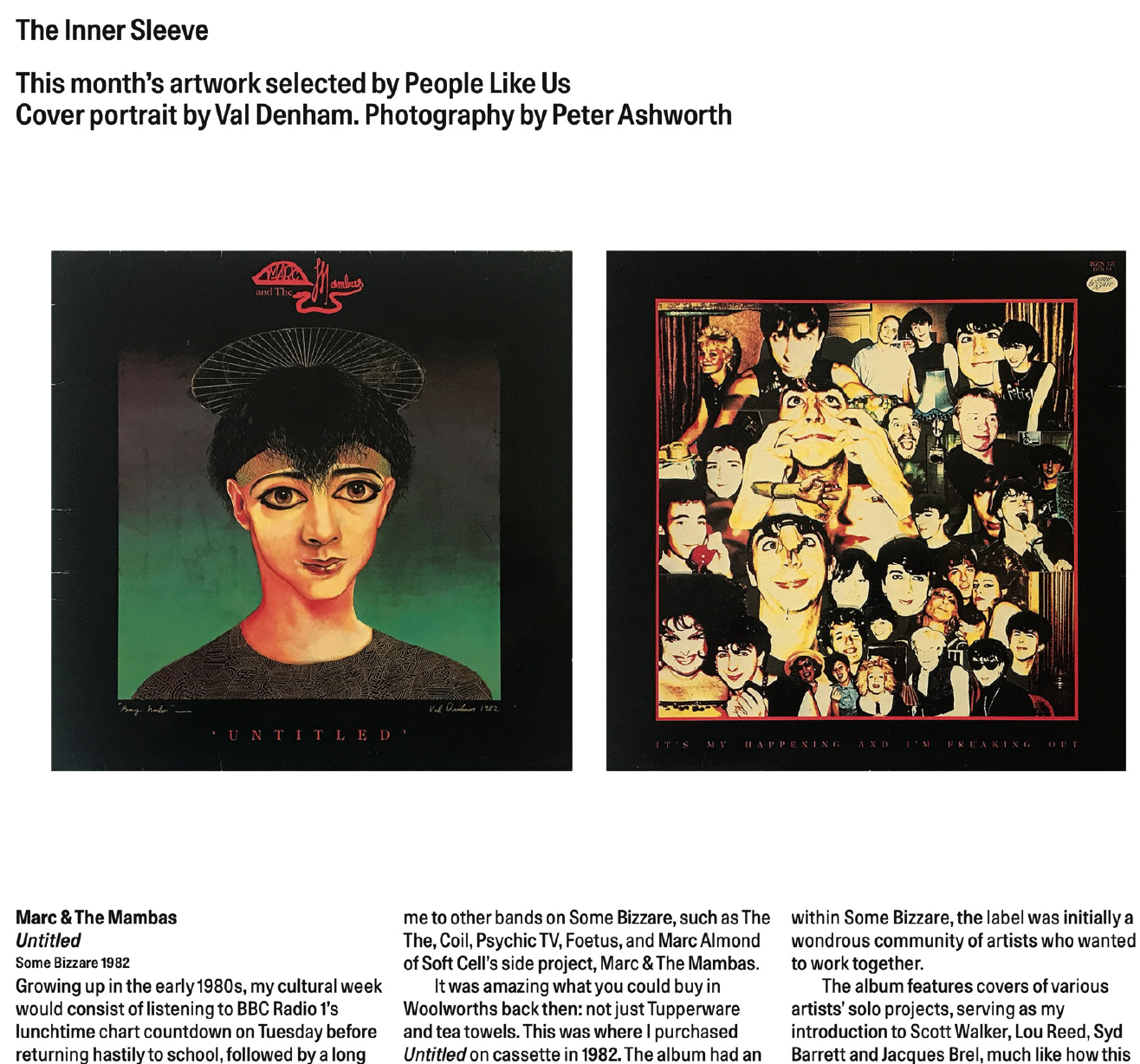
Thanks to The WIRE Magazine for having us write The Inner Sleeve feature in the new October 2023 issue of the magazine. We chose Marc & the Mambas “Untitled”.
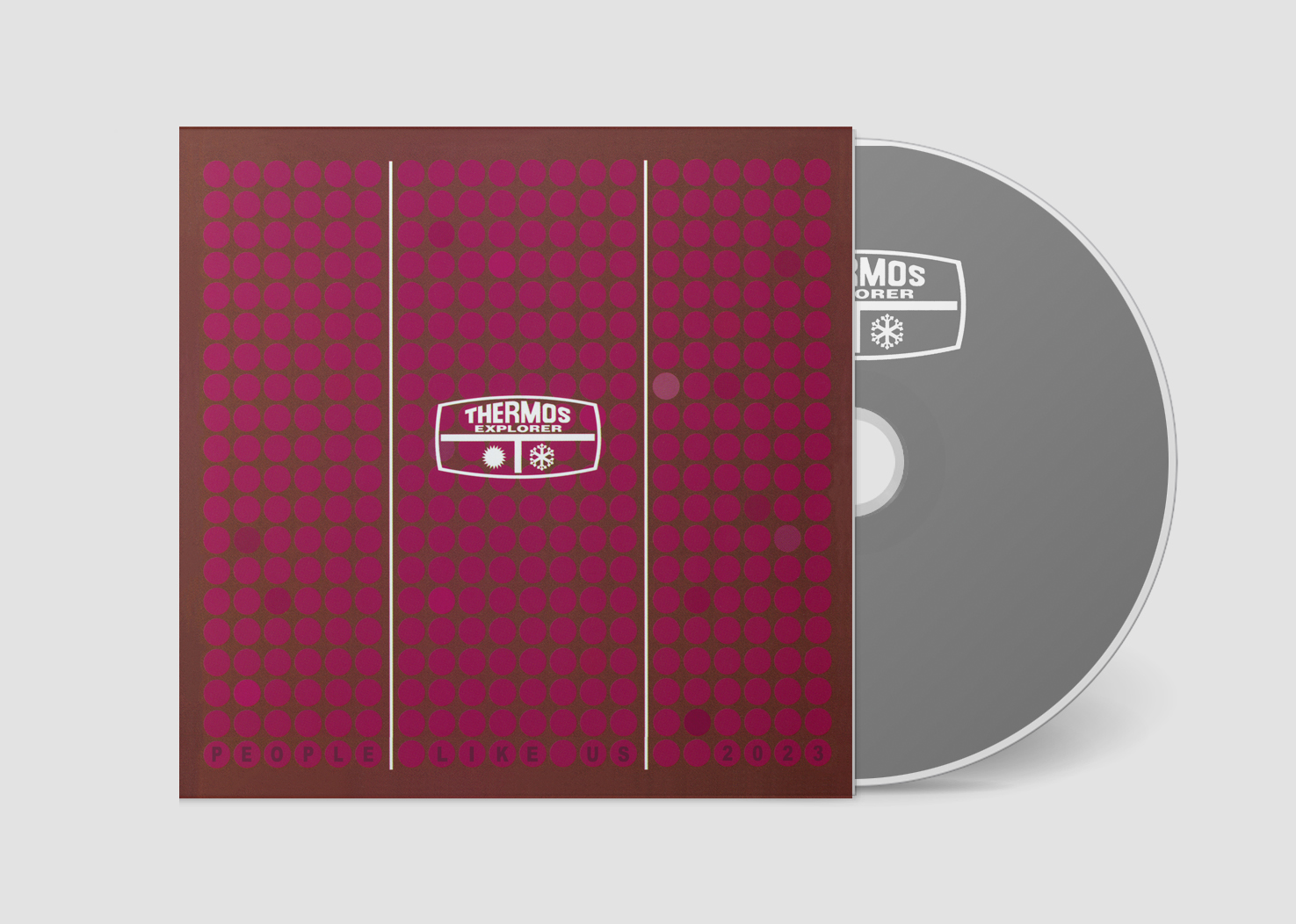
Recently when compiling tracks for our retrospective double CD “Sharity!” we noticed what unique energy the Thermos Explorer (2000) period of People Like Us has. It represents to us the time when quite a lot of changes were happening, the dawn of fast internet and affordable computers, napster and email, and for People Like Us the same time marks personal changes – having been seriously injured in a hit-and-run accident and spending much of the time making this being pretty immobile (hence inner sleeve artwork, by Matt Wand!), and once out of hospital deciding to go to the US for the first time to visit various friends made as a result of all the networking that had suddenly become possible.
Also, that time brought an interesting transition for technology from analogue, early digital (MiniDisc) editing, having a wonderful Roland DJ70 sampling keyboard, yet not quite having a fast enough computer yet…
Thermos Explorer was originally released in 2000 on the wonderful Hot Air label, and that first edition went out of print maybe 15 years or so ago. So here we are bringing this special album back to life. People Like Us has changed quite a bit over the years, and this is a time capsule of a new century and lots of new opportunities, new collaborations, and new friends.