Since 1991, British artist Vicki Bennett has been working under the name People Like Us, creating audio-visual collage across music, film, radio, live performance and immersive installations. Drawing on the vast archive of popular culture, she repurposes familiar sounds and images to create unexpected connections, often with a dark sense of humour and an interest in the absurd. Through the process of collage, fragments are removed from their original contexts and brought into new relationships, producing meanings that are more than the sum of their parts.
Vicki sees collage as a form of contemporary folk art, drawing on the shared palette of media and technology, with all the borrowing, sharing and cross-referencing that implies. Central to her practice is the premise that everything is interconnected, and that claiming ownership of an entirely “original” or isolated idea is both preposterous and redundant. Sampling is not simply a compositional technique but a way of thinking about how meaning emerges through association, juxtaposition and the rearrangement of what already exists.
Her work ranges from the long-running DO or DIY radio programme on WFMU and large-scale experimental broadcasts such as Radio Boredcast, to the immersive cinema installation Gone, Gone Beyond and the live audiovisual performance The Library of Babel. In 2006, she became the first artist granted unrestricted access to the BBC archives, having previously recorded a session for John Peel in 2003. People Like Us has presented work internationally at venues, galleries and festivals including Barbican, Whitechapel Gallery, MACBA (Barcelona), MAXXI (Rome), Haus der Kulturen der Welt (Berlin), Hallwalls Contemporary Arts Center (Buffalo), HMKV (Dortmund), Sheehan Gallery (Walla Walla), Gray Area (San Francisco), Venice Biennale, Sónar, transmediale, Café OTO, Attenborough Centre for the Creative Arts and donaufestival (Austria).
Working under the moniker People Like Us, British artist Vicki Bennett has been creating audio-visual collage since 1991. Her extensive output spans music releases, radio broadcasts, films, live performances, gallery installations, 360° immersive environments and online media. Vicki treats collage as a form of contemporary folk art, rooted in the shared materials of mass media and technology. Central to her work is the belief that everything is interconnected, making the notion of absolute originality or isolated artistic ownership both questionable and unnecessary. Through collage, familiar sounds and images are brought into new relationships, producing unexpected meanings that extend beyond the sum of their parts.
Throughout her practice, Vicki has explored how we make sense of the world through the material already around us. Films, music, television, radio and archives provide a collective vocabulary, full of associations that change according to how they are encountered and rearranged. Sampling allows these existing fragments to take on different meanings, often revealing connections that were not apparent in their original contexts. Rather than treating the archive as a repository of fixed objects, her work approaches it as something continually being made and remade through use.
Since 2002, the majority of the People Like Us back catalogue has been freely accessible online. Vicki is a long-standing advocate of the gift economy and open access to cultural archives, demonstrating how self-distribution can create greater reach and longevity than conventional publishing channels. The discography and filmography of People Like Us have been generously hosted by UbuWeb, reflecting a commitment to sharing and cultural circulation that extends throughout her practice. In 2006, she became the first artist granted unrestricted access to the BBC archives.
Radio has been particularly important to Vicki’s exploration of how material can be collected, juxtaposed and experienced collectively. Her long-running programme DO or DIY has been broadcast on New York’s independent WFMU since 2003, continuing a practice of experimental broadcasting that began in the 1990s. Her large-scale radio projects have frequently challenged the boundaries of the medium itself. Radio Boredcast (AV Festival, 2012) was a 744-hour online radio station featuring new commissions and archival material, while Optimized! Expanded Radio (2016) transformed WFMU’s Monty Hall into a week-long online audiovisual radio station, combining live broadcasts, films, performances and audience participation. Later works include the crowdsourced radio project No One Is An Island (2016), the 22-hour commission 108 for Radio Art Zone (2022), and Changing Your Mind for Deutschlandradio. These projects investigate radio not only as a means of transmission but as a shared space in which unexpected relationships can emerge.
Vicki’s work in radio also extends to curation. In 2016 she co-curated Optimized! Expanded Radio with John Kilduff at WFMU’s Monty Hall, an experimental week-long online audiovisual station and artist residency funded by the National Endowment for the Arts. The project brought commissioned works, live broadcasts, an interactive AccuPlaylist and audience participation together across physical and online spaces.
The same approach extends to her film and performance work, where familiar images and narratives are separated from their original contexts and made to interact. Notations (2013), a touring film created for live musical improvisation, opened up the relationship between the fixed image and its changing musical accompaniment. Citation City (2015), drawing on Walter Benjamin’s The Arcades Project, reconstructed London through its appearances in feature films, using cinematic fragments to create an alternative geography of the city. Other works include the documentary Nothing Can Turn Into A Void (2015) and The Library of Babel, developed from 2023 onwards as a live audiovisual performance inspired by Jorge Luis Borges’ story of the same name. Developed through an Indiegogo campaign, The Library of Babel was first previewed during a three-day People Like Us residency curated by Vicki at Café OTO, London, in October 2023. Alongside its solo presentation, the programme brought together Maggie Nicols, Ergo Phizmiz, Gwilly Edmondez, Porest, Irene Moon, Erik Bünger and Hearty White in a mixture of performances, collaborations and conversation. The work has since travelled internationally, including presentations at the Vostell Museum, donaufestival, WFMU’s Monty Hall, Other Cinema in San Francisco and wildpop in Newcastle.
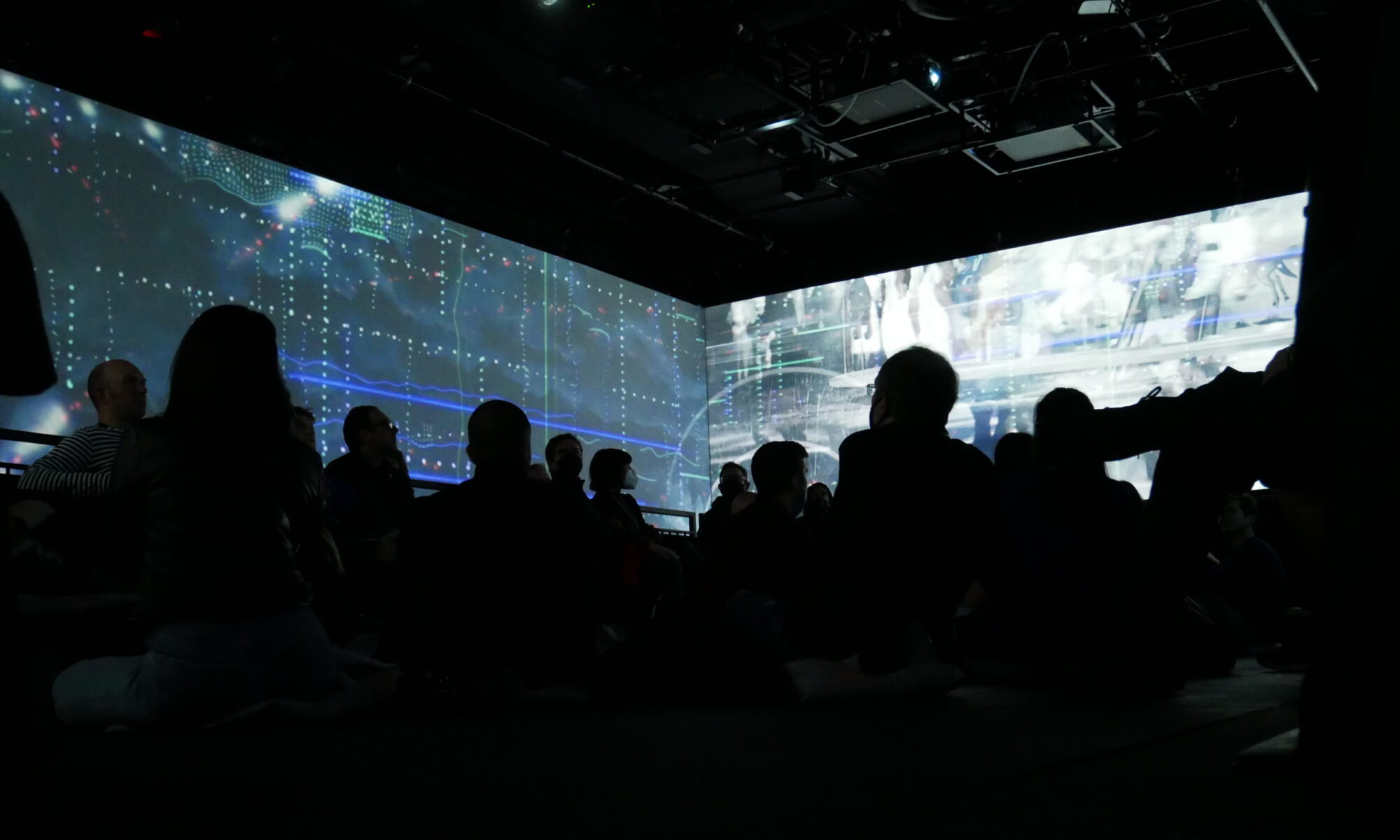
Vicki’s interest in the relationships between images, sound and their surroundings has increasingly taken her work beyond the conventional single screen. Her solo exhibition First Person, Fourth Wall (2020) at Hallwalls Contemporary Arts Center, Buffalo, formed part of the Hallwalls Artist in Residence Project. Gone, Gone Beyond (2021), developed for Recombinant Media Labs’ CineChamber, used ten screens and eight speakers to create an immersive audiovisual environment surrounding the audience. Rather than directing attention towards a single image, the work allowed viewers to encounter multiple simultaneous perspectives while sharing the same physical space. The installation toured internationally, including presentations at nyMusikk Oslo, SPILL Festival, Attenborough Centre for the Creative Arts and London’s Barbican. This exploration continued with Mise en Abyme (2024), a widescreen, multispeaker audiovisual installation presented at Museu de Aveiro/Santa Joana in Portugal as part of Aveiro’s year as Portuguese Capital of Culture.
The processes of collecting, arranging and making associations are also visible in the structures through which Vicki develops her work. Her mind maps, lists and networks of references form a parallel visual practice, allowing ideas and materials to remain connected without necessarily imposing a fixed hierarchy. In 2022, she presented MIND MAPS: The Art of Vicki Bennett at Sheehan Gallery in the USA and Orfeó Lleidatà in Spain. The exhibition brought aspects of this associative approach into the gallery, revealing relationships between the finished works and the processes through which they emerge.
Music remains central to People Like Us, with more than 50 audio recordings released on labels including Illegal Art, Rough Trade, Soleilmoon Recordings, Discrepant, Sonic Arts Network and Touch. Her 2018 album The Mirror, accompanied by an audiovisual performance, was ranked No. 8 in The Wire‘s Albums of the Year. The retrospective double CD Sharity! Selected Works of People Like Us followed in 2023, and COPIA, the first new studio album since The Mirror, was released in 2024 and subsequently issued on vinyl by Discrepant in 2025. In 2026, Vicki began preparing THE RHiZOME in association with the relaunch of Illegal Art, continuing her exploration of musical recombination, association and transformation.
Alongside her own releases and performances, Vicki has produced an extensive body of commissioned moving-image work for other musicians. This includes films for The The, working with director Tim Pope, and videos for Marc Almond, The Soft Pink Truth and Soft Cell. During 2025 and 2026, her collaboration with Soft Cell expanded considerably, encompassing films for live performances and music videos associated with Danceteria, including Out Come The Freaks, In Heaven (When I Dance With You) and The Rainbow Room, as well as work with JG Thirlwell. These collaborations extend her approach to sampling into dialogue with other artists’ music, finding visual correspondences through association rather than literal illustration.
Over more than three decades, People Like Us has been presented internationally at venues including Tate Modern, Whitechapel Gallery, BFI, Barbican, ICA, V&A, Centre Pompidou (Paris), Sónar (Barcelona), MAXXI (Rome), Venice Biennale, Walker Art Center (Minneapolis), Sydney Opera House and Centro de Cultura Digital (Mexico City). Vicki’s films have been broadcast on Channel 4, while her radio work has included sessions for John Peel and Mixing It, alongside commissions for WDR and Deutschlandradio. Her work has been commissioned by organisations including Arts Council England, Barbican, Attenborough Centre for the Creative Arts, BBC, PRS Foundation, Great North Run, Sound and Music, AV Festival, Recombinant Media Labs, Sonic Arts Network, Animate Projects, Forma, LUX and Lovebytes. She has held numerous solo exhibitions and participated in international group exhibitions at institutions including HMKV (Dortmund), Hatton Gallery (Newcastle), Sheehan Gallery (Walla Walla), Hallwalls (New York), Edinburgh Printmakers and Pallant House (Chichester). Earlier moving-image commissions included Parade (2009), created for the Great North Run Cultural Programme using footage from the event’s archive.
In 2014 Vicki co-authored The Fundamental Questions with Gregor Weichbrodt (second edition, 2020). She was featured on the cover of The Wire in May 2021 (issue 447, interview by Abi Bliss), and appointed George A. Miller Visiting Artist at the University of Illinois for 2024–25.
Vicki is currently undertaking a practice-based PhD, where her research extends the ideas developed through more than thirty years of sampling and collage. Questions of memory, association, authorship and interconnectedness, long present in her artistic work, are now also explored through writing and research. Her interest in the relationship between human creativity and technological systems reflects a continuing engagement with the tools and conditions through which culture is produced, circulated and transformed.
Her writing has appeared in The Wire, including the 2026 essay Authorship Under Automation?, which examines the changing boundaries between human and machine creativity and their implications for artistic authorship. Her work has also been discussed in publications including Cutting Across Media (Duke University Press), Sensations of History (University of Minnesota Press), Kenneth Goldsmith’s Duchamp Is My Lawyer (Columbia University Press) and Carl Abrahamsson’s Different People (Trapart). People Like Us has been reviewed or profiled in The Wire, Rolling Stone, Frieze, The Guardian, NME, Sight & Sound, Film Comment, The Independent, Record Collector and numerous other publications.
Citation City is a 42 minute audiovisual performance work which sources, collages and edits 300 major feature films where content is either filmed or set in London – creating a story within a story, of the film world, living its life, through extraordinary times of change, to see what happens when these multiple narratives are combined… what will the story tell us that one story alone could never tell?
“The result is a sweeping panorama of London, a London as represented through cinema – not the real city at all, but one that exists in the collective imagination of moviegoers throughout the decades.” Filmmaker Magazine
Please note: this is now retired. However, we occasionally make edits available as stand-alone movies for cinema screening.
A time-travelling voyage through one city, assembled from hundreds of movie clips and inspired by the wanderings of Walter Benjamin. A patchwork of over 300 features either filmed or set in London, Citation City combines multiple narratives to create the story of one city in a period of enormous change. Pieced together by audiovisual artist Vicki Bennett (aka People Like Us), this beguiling, labyrinthine work takes its cue from Benjamin’s Arcades Project, an ambitious attempt to map out Paris in fragments which was cut short by the author’s death in 1940. Flatpack Film Festival
Background: Inspired by The Arcades Project by Walter Benjamin, this audiovisual performance work by People Like Us is created from 1000s of clippings of text and visual media, collaged using a system of “convolutes”, collated around subjects of key motifs, historical figures, social types, cultural objects from the time. By gathering and assembling such groups of similar yet unrelated, he revealed a hidden, magical encyclopaedia of affinities, a massive and labyrinthine architecture of a collective dream city. On reading Benjamin, his approach to editing astonished Vicki Bennett, and the similarity of their creative processes of cutting and collating extensive lists of subject matter by context.
As a side project, Vicki also invited selected sound artists to create distinct soundtracks to the work in order to produce two new films.
Performances: 9 December 2014 Cafe Oto preview http://www.cafeoto.co.uk/jennifer-walshe-sharon-gal-andie-brown-people-like-us.shtm 29 January 2015 World Premiere attransmediale, Haus der Kulturen der Welt, Berlin 28 March 2015 UK Premiere at Flatpack Film Festival, Birmingham, as part of a larger WFMU and Walter Benjamin-themed programme 17 April 2015 Parede, Portugal 18 September 2015 Bristol Encounters Short Film Festival 26 September 2015Whitechapel Gallery at Walter Benjamin Now Symposium (at 5pm), London 15 October 2015 Leeds Art Gallery (private screening for students only) 24 October 2015 Monty Hall, WFMU 28 October 2015 Red Room, Baltimore 21 November 2015Brighton Cinecity Festival 12 April 2016 Sonic Protest Festival, Paris 7 May 2016 Delco Festival, Nimes 23 November 2016 Dundee Contemporary Arts March 2017 Hull UK City of Culture/ReROOTed Citation City is now retired. However we now make it available for movie screenings. October 2017Other Cinema, San Francisco (20-minute stand alone movie edit) December 2019 Dare Conference, Ghent (screening)
Vicki’s working process
A portion of Citation City previewed at London’s Cafe Oto on 9 December 2014 then World Premiered in full at transmediale, Berlin on 29 January 2015. It’s UK Premiere was at Flatpack Film Festival on 28 March 2015, and London Premiere at Whitechapel Gallery on 26 September 2015 as part of the Walter Benjamin Now Symposium.
Vicki’s working process
Citation City education/teaching pack PDF download: citation city teaching pack We thought it may be useful to make a document explaining the process of making this work. This pdf is intended as a companion to the audiovisual work, giving examples of the process one might undertake to create new work when sourcing from a large media database. This particular example relates to moving image and musical composition, but the methods can translate to other platforms that use composition, directing, editing, creative narratives and story telling.
SELECTION: Layout in paper form of descriptions of selected film content and possible subject headings (convolutes/citations) – August 2014
Vicki’s working processThe first stage after selecting footage is to type out descriptions of hundreds of segments then cut them out, and make arrangements of subjects, content, “convolutes”Citation CityVicki’s working process
Vicki Bennett/People Like Us Since 1991 British artist Vicki Bennett has been working across the field of audio-visual collage, and is recognised as an influential and pioneering figure in the still growing area of sampling, appropriation and cutting up of found footage and archives. Working under the name People Like Us, Vicki specialises in the manipulation and reworking of original sources from both the experimental and popular worlds of music, film and radio. People Like Us believe in open access to archives for creative use. In 2006 she was the first artist to be given unrestricted access to the entire BBC Archive. People Like Us have previously shown work at Tate Modern, Whitechapel Gallery, The Barbican, Centro de Cultura Digital, V&A, Sydney Opera House, Royal Albert Hall, Pompidou Centre, Venice Biennale, Maxxi and Sonar, and performed radio sessions for John Peel and Mixing It. The ongoing sound art radio show ‘DO or DIY’ on WFMU has had over a million “listen again” downloads. since 2003. The People Like Us back catalogue is available for free download hosted by UbuWeb. Longer Biography Filmography Exhibitions and Editions Selected Performances and Screenings Commissions and Awards Discography https://peoplelikeus.org/2014/artist-statement-for-people-like-us/